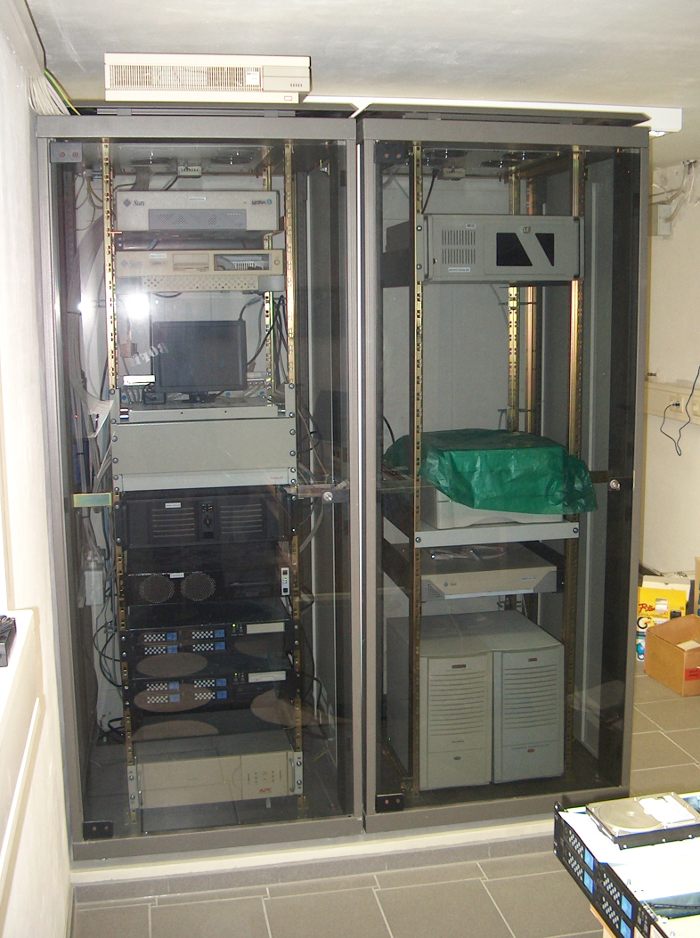
19" racks
with the infrastructure and central
server systems and a separate 12U 19" rack distributing ethernet,
telephone and satellite TV to all rooms.
moria.de
About this site
All machines
19" racks
with the infrastructure and central
server systems and a separate 12U 19" rack distributing ethernet,
telephone and satellite TV to all rooms.
moria.de
About this site
All machines
In the early years, the computer equipment at this site was pretty much a hardware zoo, but various serial terminals (DEC VT101 and VT320, Honeywell & Bull DKU7003, a bunch of Wyse 60 and Wyse 120), Sun systems (3/50, SS1+, SS4, SS5, SS10, SS20, U1, U5), a HP 735/99, a Transputer cluster and various PCs (an IBM 5162 among them) are now all gone. I regret to have sold each single one, but as a matter of fact, many would have been broken by now and it probably takes until I retire to have enough time for all systems I still own.
The heart of this site are two
19" racks
with the infrastructure and central
server systems and a separate 12U 19" rack distributing ethernet,
telephone and satellite TV to all rooms.
During the early years, the main server also served as routing firewall.
With time, the setup size and the amount of attacks asked for a dedicated
system. I used an old 2U case from the garbage, modified it to take
low profile cards and a regular power supply (cheaper to replace), put
a mini-ITX board with a Via C7 1.8 GHz CPU, 1 GB RAM, one GE and one FE
port in it and added two 2.5" SATA HDDs running as RAID1. The result was
real cheap, needs less than 40 W power and is connected to the internet
with T-DSL 16k+ for both dynamically and statically routed traffic.
Since some people asked, here is a
walkthrough of the
setup.
I used to use a 3com 1100 switch for ages, but finally 10 Mbit did not cut
it any more. The upgrade was a 3com 3300 switch that I was very satisfied
with for many years, but 3com stopped making them and I expected mine
to finally break after all the years. Moving on to gigabit ethernet,
I found the TP-Link TL-SG3424 to be perfect: 24 GE ports, web management,
CLI management much like Cisco IOS, a serial console port, very low power
demands and real cheap for the value. It connects all equipment at home using multiple
VLANs that are routed and firewalled by ti-gw. TP-Link
is not one of the traditional switch companies, but if they continue delivering
such products, they will be.
Fangorn is the development and personal compute and file server. Inside its 3U case works an Intel Atom S1260 with 8 GB RAM. It has four 2.5" SATA drives holding RAID1 groups plus a spare drive and only needs about 30W. Additionally, there is a rackmount USB serial adapter with 8 ports for various console ports.
Gandalf is the production moria server, serving mail and web pages. Currently, it has a 2U case with an Atom D510, 2 GB RAM and two 250 GB SATA notebook drives configured as RAID1.
Netio is a Raspberry Pi in a 1U case, connected to a GPS receiver for stratum 1 NTP service and to the 1-wire home network.
Palantir is a diskless Sun IPC, equipped with a mini-ITX board,
running GNU/Linux and used as my workstation in the living room. It has 16
GB RAM and a Pentium J4205 at 1.5 GHz CPU. Its 32" monitor is an ViewSonic
32", used at a resolution of 2560x1440 with TrueColor. Additionally,
there is are two modified SCSI enclosures containing
an USB chipcard reader and a USB IDE DVD recorder.
Casemodding rulez!